Artillery is a class of heavy military ranged weapons that launch munitions far beyond the range and power of infantry firearms. Early artillery development focused on the ability to breach defensive walls and fortificationsduring sieges, and led to heavy, fairly immobile siege engines. As technology improved, lighter, more mobile field artillerycannons developed for battlefield use. This development continues today; modern self-propelled artillery vehicles are highly mobile weapons of great versatility generally providing the largest share of an army's total firepower.

Originally, the word "artillery" referred to any group of soldiers primarily armed with some form of manufactured weapon or armor. Since the introduction of gunpowder and cannon, "artillery" has largely meant cannons, and in contemporary usage, usually refers to shell-firing guns, howitzers, and mortars(collectively called cannon artillery, gun artillery or tube artillery), and rocket artillery. In common speech, the word "artillery" is often used to refer to individual devices, along with their accessories and fittings, although these assemblages are more properly called "equipment". However, there is no generally recognized generic term for a gun, howitzer, mortar, and so forth: the United States uses "artillery piece", but most English-speaking armies use "gun" and "mortar". The projectiles fired are typically either "shot" (if solid) or "shell" (if not solid). Historically, variants of solid shot including canister, chain shot and grapeshot were also used. "Shell" is a widely used generic term for a projectile, which is a component of munitions.
By association, artillery may also refer to the arm of service that customarily operates such engines. In some armies, the artillery arm has operated field, coastal, anti-aircraft, and anti-tank artillery; in others these have been separate arms, and with some nations coastal has been a naval or marine responsibility.
In the 20th century, technology-based target acquisition devices (such as radar) and systems (such as sound ranging and flash spotting) emerged in order to acquire targets, primarily for artillery. These are usually operated by one or more of the artillery arms. The widespread adoption of indirect fire in the early 20th century introduced the need for specialist data for field artillery, notably survey and meteorological, and in some armies, provision of these are the responsibility of the artillery arm.
Artillery has been used since at least the early Industrial Revolution. The majority of combat deaths in the Napoleonic Wars, World War I, and World War II were caused by artillery.[1] In 1944, Joseph Stalin said in a speech that artillery was "the god of war".[1]
Artillery piece

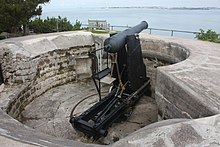
Although not called as such, siege engines performing the role recognizable as artillery have been employed in warfare since antiquity. The first known catapult was developed in Syracuse in 399 BC.[2] Until the introduction of gunpowder into western warfare, artillery was dependent upon mechanical energy which not only severely limited the kinetic energy of the projectiles, it also required the construction of very large engines to store sufficient energy. A 1st-century BC Roman catapult launching 6.55 kg (14.4 lb) stones achieved a kinetic energy of 16,000 joules, compared to a mid-19th-century 12-pounder gun, which fired a 4.1 kg (9.0 lb) round, with a kinetic energy of 240,000 joules, or a 20th-century US battleship that fired a 1,225 kg (2,701 lb) projectile from its main battery with an energy level surpassing 350,000,000 joules.
From the Middle Ages through most of the modern era, artillery pieces on land were moved by horse-drawn gun carriages. In the contemporary era, artillery pieces and their crew relied on wheeled or tracked vehicles as transportation. These land versions of artillery were dwarfed by railway guns; the largest of these large-calibre guns ever conceived – Project Babylon of the Supergun affair – was theoretically capable of putting a satellite into orbit. Artillery used by naval forces has also changed significantly, with missiles generally replacing guns in surface warfare.
Over the course of military history, projectiles were manufactured from a wide variety of materials, into a wide variety of shapes, using many different methods in which to targetstructural/defensive works and inflict enemy casualties. The engineering applications for ordnance delivery have likewise changed significantly over time, encompassing some of the most complex and advanced technologies in use today.
In some armies, the weapon of artillery is the projectile, not the equipment that fires it. The process of delivering fire onto the target is called gunnery. The actions involved in operating an artillery piece are collectively called "serving the gun" by the "detachment" or gun crew, constituting either direct or indirect artillery fire. The manner in which gunnery crews (or formations) are employed is called artillery support. At different periods in history, this may refer to weapons designed to be fired from ground-, sea-, and even air-based weapons platforms.
Crew
Some armed forces use the term "gunners" for the soldiers and sailors with the primary function of using artillery.
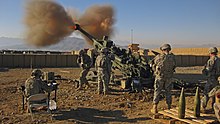
The gunners and their guns are usually grouped in teams called either "crews" or "detachments". Several such crews and teams with other functions are combined into a unit of artillery, usually called a battery, although sometimes called a company. In gun detachments, each role is numbered, starting with "1" the Detachment Commander, and the highest number being the Coverer, the second-in-command. "Gunner" is also the lowest rank, and junior non-commissioned officers are "Bombardiers" in some artillery arms.
Batteries are roughly equivalent to a companyin the infantry, and are combined into larger military organizations for administrative and operational purposes, either battalions or regiments, depending on the army. These may be grouped into brigades; the Russian army also groups some brigades into artillery divisions, and the People's Liberation Armyhas artillery corps.
The term "artillery" also designates a combat arm of most military services when used organizationally to describe units and formations of the national armed forces that operate the weapons.
Tactics
During military operations, field artillery has the role of providing support to other arms in combat or of attacking targets, particularly in-depth. Broadly, these effects fall into two categories, aiming either to suppress or neutralize the enemy, or to cause casualties, damage, and destruction. This is mostly achieved by delivering high-explosive munitions to suppress, or inflict casualties on the enemy from casing fragments and other debris and from blast, or by destroying enemy positions, equipment, and vehicles. Non-lethal munitions, notably smoke, can also suppress or neutralize the enemy by obscuring their view.
Fire may be directed by an artillery observeror another observer, including crewed and uncrewed aircraft, or called onto map coordinates.
Military doctrine has had a significant influence on the core engineering designconsiderations of artillery ordnance through its history, in seeking to achieve a balance between the delivered volume of fire with ordinance mobility. However, during the modern period, the consideration of protecting the gunners also arose due to the late-19th-century introduction of the new generation of infantry weapons using conoidal bullet, better known as the Minié ball, with a range almost as long as that of field artillery.
The gunners' increasing proximity to and participation in direct combat against other combat arms and attacks by aircraft made the introduction of a gun shield necessary. The problems of how to employ a fixed or horse-towed gun in mobile warfare necessitated the development of new methods of transporting the artillery into combat. Two distinct forms of artillery were developed: the towed gun, used primarily to attack or defend a fixed-line; and the self-propelled gun, intended to accompany a mobile force and to provide continuous fire support and/or suppression. These influences have guided the development of artillery ordnance, systems, organizations, and operations until the present, with artillery systems capable of providing support at ranges from as little as 100 m to the intercontinental ranges of ballistic missiles. The only combat in which artillery is unable to take part in is close-quarters combat, with the possible exception of artillery reconnaissance teams.[3]
Etymology
The word as used in the current context originated in the Middle Ages. One suggestion is that it comes from french atelier, meaning the place where manual work is done.
Another suggestion is that it originates from the 13th century and the Old French artillier, designating craftsmen and manufacturers of all materials and warfare equipments (spears, swords, armor, war machines); and, for the next 250 years, the sense of the word "artillery" covered all forms of military weapons. Hence, the naming of the Honourable Artillery Company, which was essentially an infantry unit until the 19th century.
Another suggestion is that it comes from the Italian arte de tirare (art of shooting), coined by one of the first theorists on the use of artillery, Niccolò Tartaglia.
History

Mechanical systems used for throwing ammunition in ancient warfare, also known as "engines of war", like the catapult, onager, trebuchet, and ballista, are also referred to by military historians as artillery.
Medieval
During medieval times, more types of artillery were developed, most notably the trebuchet. Traction trebuchets, using manpower to launch projectiles, have been used in ancient China since the 4th century as anti-personnel weapons. However, in the 12th century, the counterweight trebuchet was introduced, with the earliest mention of it being in 1187.[4]
Invention of gunpowder

Early Chinese artillery had vase-like shapes. This includes the "long range awe inspiring" cannon dated from 1350 and found in the 14th century Ming Dynasty treatise Huolongjing.[5]With the development of better metallurgy techniques, later cannons abandoned the vase shape of early Chinese artillery. This change can be seen in the bronze "thousand ball thunder cannon", an early example of field artillery.[6] These small, crude weapons diffused into the Middle East (the madfaa) and reached Europe in the 13th century, in a very limited manner.
In Asia, Mongols adopted the Chinese artillery and used it effectively in the great conquest. By the late 14th century, Chinese rebels used organized artillery and cavalry to push Mongols out. The usage of cannons in the Mongol invasion of Java,[7] led to deployment of cetbang cannons by Majapahit fleet in the 1300s and subsequent near universal use of the swivel-gun and cannons in the Nusantara archipelago.[8][9]
As small smooth-bore tubes, these were initially cast in iron or bronze around a core, with the first drilled bore ordnance recorded in operation near Seville in 1247.[citation needed]They fired lead, iron, or stone balls, sometimes large arrows and on occasions simply handfuls of whatever scrap came to hand. During the Hundred Years' War, these weapons became more common, initially as the bombard and later the cannon. Cannon were always muzzle-loaders. While there were many early attempts at breech-loading designs, a lack of engineering knowledge rendered these even more dangerous to use than muzzle-loaders.
Expansion of use


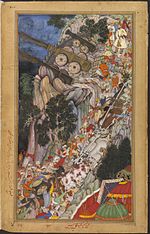
In 1415, the Portuguese invaded the Mediterranean port town of Ceuta. While it is difficult to confirm the use of firearms in the siege of the city, it is known the Portuguese defended it thereafter with firearms, namely bombardas, colebratas, and falconetes. In 1419, Sultan Abu Sa'id led an army to reconquer the fallen city, and Marinids brought cannons and used them in the assault on Ceuta. Finally, hand-held firearms and riflemen appear in Morocco, in 1437, in an expedition against the people of Tangiers.[12][page needed] It is clear these weapons had developed into several different forms, from small guns to large artillery pieces.
The artillery revolution in Europe caught on during the Hundred Years' War and changed the way that battles were fought. In the preceding decades, the English had even used a gunpowder-like weapon in military campaigns against the Scottish.[13] However, at this time, the cannons used in battle were very small and not particularly powerful. Cannons were only useful for the defense of a castle, as demonstrated at Breteuil in 1356, when the besieged English used a cannon to destroy an attacking French assault tower.[14]By the end of the 14th century, cannon were only powerful enough to knock in roofs, and could not penetrate castle walls.
However, a major change occurred between 1420 and 1430, when artillery became much more powerful and could now batter strongholds and fortresses quite efficiently. The English, French, and Burgundians all advanced in military technology, and as a result the traditional advantage that went to the defense in a siege was lost. The cannon during this period were elongated, and the recipe for gunpowder was improved to make it three times as powerful as before.[15] These changes led to the increased power in the artillery weapons of the time.
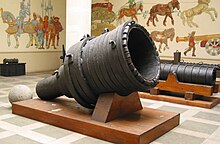
Joan of Arc encountered gunpowder weaponry several times. When she led the French against the English at the Battle of Tourelles, in 1430, she faced heavy gunpowder fortifications, and yet her troops prevailed in that battle. In addition, she led assaults against the English-held towns of Jargeau, Meung, and Beaugency, all with the support of large artillery units. When she led the assault on Paris, Joan faced stiff artillery fire, especially from the suburb of St. Denis, which ultimately led to her defeat in this battle. In April 1430, she went to battle against the Burgundians, whose support was purchased by the English. At this time, the Burgundians had the strongest and largest gunpowder arsenal among the European powers, and yet the French, under Joan of Arc's leadership, were able to beat back the Burgundians and defend themselves.[17] As a result, most of the battles of the Hundred Years' War that Joan of Arc participated in were fought with gunpowder artillery.
The army of Mehmet the Conqueror, which conquered Constantinople in 1453, included both artillery and foot soldiers armed with gunpowder weapons.[18] The Ottomans brought to the siege sixty-nine guns in fifteen separate batteries and trained them at the walls of the city. The barrage of Ottoman cannon fire lasted forty days, and they are estimated to have fired 19,320 times.[19]Artillery also played a decisive role in the Battle of St. Jakob an der Birs of 1444. Early cannon were not always reliable; King James II of Scotland was killed by the accidental explosion of one of his own cannon, imported from Flanders, at the siege of Roxburgh Castle in 1460.
The new Ming Dynasty established the "Divine Engine Battalion" (神机营), which specialized in various types of artillery. Light cannons and cannons with multiple volleys were developed. In a campaign to suppress a local minority rebellion near today's Burmese border, "the Ming army used a 3-line method of arquebuses/muskets to destroy an elephant formation."[20]
When the Portuguese and Spanish arrived at Southeast Asia, they found that the local kingdoms were already using cannons. One of the earliest reference to cannon and artillerymen in Java is from the year 1346.[21]Portuguese and Spanish invaders were unpleasantly surprised and even outgunned on occasion.[22] Duarte Barbosa ca. 1514 said that the inhabitants of Java were great masters in casting artillery and very good artillerymen. They made many one-pounder cannons (cetbang or rentaka), long muskets, spingarde (arquebus), schioppi (hand cannon), Greek fire, guns (cannons), and other fire-works. Every place are considered excellent in casting artillery, and in the knowledge of using it.[23]: 254 [24]: 198 [25]: 224 In 1513, the Javanese fleet led by Pati Unus sailed to attack Portuguese Malacca "with much artillery made in Java, for the Javanese are skilled in founding and casting, and in all works in iron, over and above what they have in India".[26]: 162 [27]: 23 By the early 16th century, the Javanese already locally-producing large guns, some of them still survived until the present day and dubbed as "sacred cannon" or "holy cannon". These cannons varied between 180 and 260 pounders, weighing anywhere between 3–8 tons, measuring between 3–6 m.[28]
Between 1593 and 1597, about 200,000 Korean and Chinese troops which fought against Japan in Korea actively used heavy artillery in both siege and field combat. Korean forces mounted artillery in ships as naval guns, providing an advantage against Japanese navy which used Kunikuzushi (国崩し – Japanese breech-loading swivel gun) and Ōzutsu (大筒 – large size Tanegashima) as their largest firearms.[29][30]
Smoothbores
Bombards were of value mainly in sieges. A famous Turkish example used at the siege of Constantinople in 1453 weighed 19 tons[vague], took 200 men and sixty oxen to emplace, and could fire just seven times a day. The Fall of Constantinople was perhaps "the first event of supreme importance whose result was determined by the use of artillery" when the huge bronze cannons of Mehmed II breached the city's walls, ending the Byzantine Empire, according to Sir Charles Oman.[31]
Bombards developed in Europe were massive smoothbore weapons distinguished by their lack of a field carriage, immobility once emplaced, highly individual design, and noted unreliability (in 1460 James II, King of Scots, was killed when one exploded at the siege of Roxburgh). Their large size precluded the barrels being cast and they were constructed out of metal staves or rods bound together with hoops like a barrel, giving their name to the gun barrel.[32][page needed]
The use of the word "cannon" marks the introduction in the 15th century of a dedicated field carriage with axle, trail and animal-drawn limber—this produced mobile field pieces that could move and support an army in action, rather than being found only in the siege and static defenses. The reduction in the size of the barrel was due to improvements in both iron technology and gunpowder manufacture, while the development of trunnions—projections at the side of the cannon as an integral part of the cast—allowed the barrel to be fixed to a more movable base, and also made raising or lowering the barrel much easier.[32]

The first land-based mobile weapon is usually credited to Jan Žižka, who deployed his oxen-hauled cannon during the Hussite Wars of Bohemia (1418–1424). However, cannons were still large and cumbersome. With the rise of musketry in the 16th century, cannon were largely (though not entirely) displaced from the battlefield—the cannon were too slow and cumbersome to be used and too easily lost to a rapid enemy advance.
The combining of shot and powder into a single unit, a cartridge, occurred in the 1620s with a simple fabric bag, and was quickly adopted by all nations. It speeded loading and made it safer, but unexpelled bag fragments were an additional fouling in the gun barrel and a new tool—a worm—was introduced to remove them. Gustavus Adolphus is identified as the general who made cannon an effective force on the battlefield—pushing the development of much lighter and smaller weapons and deploying them in far greater numbers than previously. The outcome of battles was still determined by the clash of infantry.
Shells, explosive-filled fused projectiles, were also developed in the 17th century.[33]The development of specialized pieces—shipboard artillery, howitzers and mortars—was also begun in this period. More esoteric designs, like the multi-barrel ribauldequin(known as "organ guns"), were also produced.[dubious ]
The 1650 book by Kazimierz SiemienowiczArtis Magnae Artilleriae pars prima[34] was one of the most important contemporary publications on the subject of artillery. For over two centuries this work was used in Europe as a basic artillery manual.[35]
One of the most significant effects of artillery during this period was however somewhat more indirect—by easily reducing to rubble any medieval-type fortification or city wall (some which had stood since Roman times), it abolished millennia of siege-warfare strategies and styles of fortification building.[32] This led, among other things, to a frenzy of new bastion-style fortifications to be built all over Europe and in its colonies, but also had a strong integrating effect on emerging nation-states, as kings were able to use their newfound artillery superiority to force any local dukes or lords to submit to their will, setting the stage for the absolutist kingdoms to come.[32]
Modern rocket artillery can trace its heritage back to the Mysorean rockets of India. Their first recorded use was in 1780 during the battles of the Second, Third and Fourth Mysore Wars. The wars fought between the British East India Company and the Kingdom of Mysore in India made use of the rockets as a weapon. In the Battle of Pollilur, the Siege of Seringapatam (1792) and in Battle of Seringapatam in 1799 these rockets were used with considerable effect against the British."[36] After the wars, several Mysore rockets were sent to England, but experiments with heavier payloads were unsuccessful. In 1804 William Congreve, considering the Mysorian rockets to have too short a range (less than 1,000 yards) developed rockets in numerous sizes with ranges up to 3,000 yards and eventually utilizing iron casing as the Congreve rocket which were used effectively during the Napoleonic Wars and the War of 1812.[37]
Napoleonic

With the Napoleonic Wars, artillery experienced changes in both physical design and operation. Rather than being overseen by "mechanics", artillery was viewed as its own service branch with the capability of dominating the battlefield. The success of the French artillery companies was at least in part due to the presence of specially trained artillery officers leading and coordinating during the chaos of battle.[38] Napoleon, himself a former artillery officer, perfected the tactic of massed artillery batteries unleashed upon a critical point in his enemies' line as a prelude to a decisive infantry and cavalry assault.
Physically, cannons continued to become smaller and lighter. During the Seven Years War, King Frederick II of Prussia used these advances to deploy horse artillery that could move throughout the battlefield. Frederick also introduced the reversible iron ramrod, which was much more resistant to breakage than older wooden designs. The reversibility aspect also helped increase the rate of fire, since a soldier would no longer have to worry about what end of the ramrod they were using.[39]
Jean-Baptiste de Gribeauval, a French artillery engineer, introduced the standardization of cannon design in the mid-18th century. He developed a 6-inch (150 mm) field howitzer whose gun barrel, carriage assembly and ammunition specifications were made uniform for all French cannons. The standardized interchangeable parts of these cannons down to the nuts, bolts and screws made their mass production and repair much easier. While the Gribeauval system made for more efficient production and assembly, the carriages used were heavy and the gunners were forced to march on foot (instead of riding on the limber and gun as in the British system).[40] Each cannon was named for the weight of its projectiles, giving us variants such as 4, 8, and 12, indicating the weight in pounds. The projectiles themselves included solid balls or canister containing lead bullets or other material. These canister shots acted as massive shotguns, peppering the target with hundreds of projectiles at close range.[41]The solid balls, known as round shot, was most effective when fired at shoulder-height across a flat, open area. The ball would tear through the ranks of the enemy or bounce along the ground breaking legs and ankles.[42]
Modern

The development of modern artillery occurred in the mid to late 19th century as a result of the convergence of various improvements in the underlying technology. Advances in metallurgy allowed for the construction of breech-loading rifled guns that could fire at a much greater muzzle velocity.
After the British artillery was shown up in the Crimean War as having barely changed since the Napoleonic Wars, the industrialist William Armstrong was awarded a contract by the government to design a new piece of artillery. Production started in 1855 at the Elswick Ordnance Company and the Royal Arsenal at Woolwich, and the outcome was the revolutionary Armstrong Gun, which marked the birth of modern artillery.[43][44] Three of its features particularly stand out.

First, the piece was rifled, which allowed for a much more accurate and powerful action. Although rifling had been tried on small arms since the 15th century, the necessary machinery to accurately rifle artillery was not available until the mid-19th century. Martin von Wahrendorff, and Joseph Whitworthindependently produced rifled cannon in the 1840s, but it was Armstrong's gun that was first to see widespread use during the Crimean War.[45] The cast iron shell of the Armstrong gun was similar in shape to a Minié ball and had a thin lead coating which made it fractionally larger than the gun's bore and which engaged with the gun's rifling grooves to impart spin to the shell. This spin, together with the elimination of windage as a result of the tight fit, enabled the gun to achieve greater range and accuracy than existing smooth-bore muzzle-loaders with a smaller powder charge.

His gun was also a breech-loader. Although attempts at breech-loading mechanisms had been made since medieval times, the essential engineering problem was that the mechanism could not withstand the explosive charge. It was only with the advances in metallurgy and precision engineeringcapabilities during the Industrial Revolutionthat Armstrong was able to construct a viable solution. The gun combined all the properties that make up an effective artillery piece. The gun was mounted on a carriage in such a way as to return the gun to firing position after the recoil.
What made the gun really revolutionary lay in the technique of the construction of the gun barrel that allowed it to withstand much more powerful explosive forces. The "built-up" method involved assembling the barrel with wrought-iron (later mild steel was used) tubes of successively smaller diameter.[46] The tube would then be heated to allow it to expand and fit over the previous tube. When it cooled the gun would contract although not back to its original size, which allowed an even pressure along the walls of the gun which was directed inward against the outward forces that the gun's firing exerted on the barrel.[47]
Another innovative feature, more usually associated with 20th-century guns, was what Armstrong called its "grip", which was essentially a squeeze bore; the 6 inches of the bore at the muzzle end was of slightly smaller diameter, which centered the shell before it left the barrel and at the same time slightly swaged down its lead coating, reducing its diameter and slightly improving its ballistic qualities.

Armstrong's system was adopted in 1858, initially for "special service in the field" and initially he produced only smaller artillery pieces, 6-pounder (2.5 in/64 mm) mountain or light field guns, 9-pounder (3 in/76 mm) guns for horse artillery, and 12-pounder (3 inches /76 mm) field guns.
The first cannon to contain all 'modern' features is generally considered to be the French 75 of 1897.[48][49] The gun used cased ammunition, was breech-loading, had modern sights, and a self-contained firing mechanism. It was the first field gun to include a hydro-pneumatic recoil mechanism, which kept the gun's trail and wheels perfectly still during the firing sequence. Since it did not need to be re-aimed after each shot, the crew could fire as soon as the barrel returned to its resting position. In typical use, the French 75 could deliver fifteen rounds per minute on its target, either shrapnel or melinite high-explosive, up to about 5 miles (8,500 m) away. Its firing rate could even reach close to 30 rounds per minute, albeit only for a very short time and with a highly experienced crew. These were rates that contemporary bolt action rifles could not match.
Indirect fire
Indirect fire, the firing of a projectile without relying on direct line of sight between the gun and the target, possibly dates back to the 16th century.[50] Early battlefield use of indirect fire may have occurred at Paltzig in July 1759, when the Russian artillery fired over the tops of trees,[51] and at the Battle of Waterloo, where a battery of the Royal Horse Artilleryfired shrapnel indirectly against advancing French troops.[52]
In 1882, Russian Lieutenant Colonel KG Guk published Indirect Fire for Field Artillery, which provided a practical method of using aiming points for indirect fire by describing, "all the essentials of aiming points, crest clearance, and corrections to fire by an observer".[53]
A few years later, the Richtfläche (lining-plane) sight was invented in Germany and provided a means of indirect laying in azimuth, complementing the clinometers for indirect laying in elevation which already existed. Despite conservative opposition within the German army, indirect fire was adopted as doctrine by the 1890s. In the early 1900s, Goertz in Germany developed an optical sight for azimuth laying. It quickly replaced the lining-plane; in English, it became the 'Dial Sight' (UK) or 'Panoramic Telescope' (US).
The British halfheartedly experimented with indirect fire techniques since the 1890s, but with the onset of the Boer War, they were the first to apply the theory in practice in 1899, although they had to improvise without a lining-plane sight.[54]
In the next 15 years leading up to World War I, the techniques of indirect fire became available for all types of artillery. Indirect fire was the defining characteristic of 20th-century artillery and led to undreamt of changes in the amount of artillery, its tactics, organisation, and techniques, most of which occurred during World War I.
An implication of indirect fire and improving guns was increasing range between gun and target, this increased the time of flight and the vertex of the trajectory. The result was decreasing accuracy (the increasing distance between the target and the mean point of impact of the shells aimed at it) caused by the increasing effects of non-standard conditions. Indirect firing data was based on standard conditions including a specific muzzle velocity, zero wind, air temperature and density, and propellant temperature. In practice, this standard combination of conditions almost never existed, they varied throughout the day and day to day, and the greater the time of flight, the greater the inaccuracy. An added complication was the need for survey to accurately fix the coordinates of the gun position and provide accurate orientation for the guns. Of course, targets had to be accurately located, but by 1916, air photo interpretation techniques enabled this, and ground survey techniques could sometimes be used.
In 1914, the methods of correcting firing data for the actual conditions were often convoluted, and the availability of data about actual conditions was rudimentary or non-existent, the assumption was that fire would always be ranged (adjusted). British heavy artillery worked energetically to progressively solve all these problems from late 1914 onwards, and by early 1918, had effective processes in place for both field and heavy artillery. These processes enabled 'map-shooting', later called 'predicted fire'; it meant that effective fire could be delivered against an accurately located target without ranging. Nevertheless, the mean point of impact was still some tens of yards from the target-centre aiming point. It was not precision fire, but it was good enough for concentrations and barrages. These processes remain in use into the 21st century with refinements to calculations enabled by computers and improved data capture about non-standard conditions.
The British major-general Henry Hugh Tudorpioneered armour and artillery cooperation at the breakthrough Battle of Cambrai. The improvements in providing and using data for non-standard conditions (propellant temperature, muzzle velocity, wind, air temperature, and barometric pressure) were developed by the major combatants throughout the war and enabled effective predicted fire.[55] The effectiveness of this was demonstrated by the British in 1917 (at Cambrai) and by Germany the following year (Operation Michael).
Major General J.B.A. Bailey, British Army (retired) wrote:
An estimated 75,000 French soldiers were casualties of friendly artillery fire in the four years of World War I.[57]
Precision-guidance
Modern artillery is most obviously distinguished by its long range, firing an explosive shell or rocket and a mobile carriage for firing and transport. However, its most important characteristic is the use of indirect fire, whereby the firing equipment is aimed without seeing the target through its sights. Indirect fire emerged at the beginning of the 20th century and was greatly enhanced by the development of predicted fire methods in World War I. However, indirect fire was area fire; it was and is not suitable for destroying point targets; its primary purpose is area suppression. Nevertheless, by the late 1970s precision-guided munitions started to appear, notably the US 155 mm Copperhead and its Soviet 152 mm Krasnopol equivalent that had success in Indian service. These relied on laser designation to 'illuminate' the target that the shell homed onto. However, in the early 21st century, the Global Positioning System (GPS) enabled relatively cheap and accurate guidance for shells and missiles, notably the US 155 mm Excalibur and the 227 mm GMLRS rocket. The introduction of these led to a new issue, the need for very accurate three dimensional target coordinates—the mensuration process.[58]
Weapons covered by the term 'modern artillery' include "cannon" artillery (such as howitzer, mortar, and field gun) and rocket artillery. Certain smaller-caliber mortars are more properly designated small arms rather than artillery, albeit indirect-fire small arms. This term also came to include coastal artillery which traditionally defended coastal areas against seaborne attack and controlled the passage of ships. With the advent of powered flight at the start of the 20th century, artillery also included ground-based anti-aircraft batteries.
The term "artillery" has traditionally not been used for projectiles with internal guidance systems, preferring the term "missilery", though some modern artillery units employ surface-to-surface missiles. Advances in terminal guidance systems for small munitions has allowed large-caliber guided projectiles to be developed, blurring this distinction.[59] See Long Range Precision Fires (LRPF), Joint terminal attack controller
Ammunition
One of the most important roles of logistics is the supply of munitions as a primary type of artillery consumable, their storage (ammunition dump, arsenal, magazine ) and the provision of fuzes, detonators and warheads at the point where artillery troops will assemble the charge, projectile, bomb or shell.
A round of artillery ammunition comprises four components:
- Fuze
- Projectile
- Propellant
- Primer
Fuzes
Fuzes are the devices that initiate an artillery projectile, either to detonate its High Explosive (HE) filling or eject its cargo (illuminating flare or smoke canisters being examples). The official military spelling is "fuze".[60] Broadly there are four main types:
- impact (including graze and delay)
- mechanical time including airburst
- proximity sensor including airburst
- programmable electronic detonation including airburst
Most artillery fuzes are nose fuzes. However, base fuzes have been used with armour piercing shells and for squash head (High-Explosive Squash Head (HESH) or High Explosive, Plastic (HEP) anti-tank shells. At least one nuclear shell and its non-nuclear spotting version also used a multi-deck mechanical time fuze fitted into its base.
Impact fuzes were, and in some armies remain, the standard fuze for HE projectiles. Their default action is normally 'superquick', some have had a 'graze' action which allows them to penetrate light cover and others have 'delay'. Delay fuzes allow the shell to penetrate the ground before exploding. Armor or Concrete-Piercing (AP or CP) fuzes are specially hardened. During World War I and later, ricochet fire with delay or graze fuzed HE shells, fired with a flat angle of descent, was used to achieve airburst.
HE shells can be fitted with other fuzes. Airburst fuzes usually have a combined airburst and impact function. However, until the introduction of proximity fuzes, the airburst function was mostly used with cargo munitions—for example, shrapnel, illumination, and smoke. The larger calibers of anti-aircraft artillery are almost always used airburst. Airburst fuzes have to have the fuze length (running time) set on them. This is done just before firing using either a wrench or a fuze setter pre-set to the required fuze length.
Early airburst fuzes used igniferous timers which lasted into the second half of the 20th century. Mechanical time fuzes appeared in the early part of the century. These required a means of powering them. The Thiel mechanism used a spring and escapement (i.e. 'clockwork'), Junghans used centrifugal forceand gears, and Dixi used centrifugal force and balls. From about 1980, electronic time fuzes started replacing mechanical ones for use with cargo munitions.
Proximity fuzes have been of two types: photo-electric or radar. The former was not very successful and seems only to have been used with British anti-aircraft artillery 'unrotated projectiles' (rockets) in World War II. Radar proximity fuzes were a big improvement over the mechanical (time) fuzes which they replaced. Mechanical time fuzes required an accurate calculation of their running time, which was affected by non-standard conditions. With HE (requiring a burst 20 to 30 feet (9.1 m) above the ground), if this was very slightly wrong the rounds would either hit the ground or burst too high. Accurate running time was less important with cargo munitions that burst much higher.
The first radar proximity fuzes (perhaps originally codenamed 'VT' and later called Variable Time (VT)) were invented by the British and developed by the US and initially used against aircraft in World War II. Their ground use was delayed for fear of the enemy recovering 'blinds' (artillery shells which failed to detonate) and copying the fuze. The first proximity fuzes were designed to detonate about 30 feet (9.1 m) above the ground. These air-bursts are much more lethal against personnel than ground bursts because they deliver a greater proportion of useful fragments and deliver them into terrain where a prone soldier would be protected from ground bursts.
However, proximity fuzes can suffer premature detonation because of the moisture in heavy rain clouds. This led to 'Controlled Variable Time' (CVT) after World War II. These fuzes have a mechanical timer that switched on the radar about 5 seconds before expected impact, they also detonated on impact.
The proximity fuze emerged on the battlefields of Europe in late December 1944. They have become known as the U.S. Artillery's "Christmas present", and were much appreciated when they arrived during the Battle of the Bulge. They were also used to great effect in anti-aircraft projectiles in the Pacific against kamikaze as well as in Britain against V-1 flying bombs.[61]
Electronic multi-function fuzes started to appear around 1980. Using solid-state electronics they were relatively cheap and reliable, and became the standard fitted fuze in operational ammunition stocks in some western armies. The early versions were often limited to proximity airburst, albeit with height of burst options, and impact. Some offered a go/no-go functional test through the fuze setter.
Later versions introduced induction fuze setting and testing instead of physically placing a fuze setter on the fuze. The latest, such as Junghan's DM84U provide options giving, superquick, delay, a choice of proximity heights of burst, time and a choice of foliage penetration depths.
A new type of artillery fuze will appear soon. In addition to other functions these offer some course correction capability, not full precision but sufficient to significantly reduce the dispersion of the shells on the ground.
Projectiles
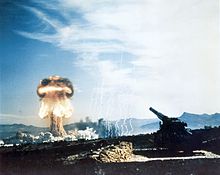
The projectile is the munition or "bullet" fired downrange. This may be an explosive device. Projectiles have traditionally been classified as "shot" or "shell", the former being solid and the latter having some form of "payload".
Shells can be divided into three configurations: bursting, base ejection or nose ejection. The latter is sometimes called the shrapnel configuration. The most modern is base ejection, which was introduced in World War I. Base and nose ejection are almost always used with airburst fuzes. Bursting shells use various types of fuze depending on the nature of the payload and the tactical need at the time.
Payloads have included:
- Bursting: high-explosive, white phosphorus, coloured marker, chemical, nuclear devices; high-explosive anti-tank and canister may be considered special types of bursting shell.
- Nose ejection: shrapnel, star, incendiary and flechette (a more modern version of shrapnel).
- Base ejection: Dual-Purpose Improved Conventional Munition bomblets, which arm themselves and function after a set number of rotations after having been ejected from the projectile (this produces unexploded sub-munitions, or "duds", which remain dangerous), scatterable mines, illuminating, coloured flare, smoke, incendiary, propaganda, chaff[62] (foil to jam radars)[63] and modern exotics such as electronic payloads and sensor-fuzed munitions.
Stabilization
- Rifled: Artillery projectiles have traditionally been spin-stabilised, meaning that they spin in flight so that gyroscopicforces prevent them from tumbling. Spin is induced by gun barrels having rifling, which engages a soft metal band around the projectile, called a "driving band" (UK) or "rotating band" (U.S.). The driving band is usually made of copper, but synthetic materials have been used.
- Smoothbore/fin-stabilized: In modern artillery, smoothbore tubes have been used mostly by mortars. These projectiles use fins in the airflow at their rear to maintain correct orientation. The primary benefits over rifled barrels is reduced barrel wear, longer ranges that can be achieved (due to the reduced loss of energy to friction and gas escaping around the projectile via the rifling) and larger explosive cores for a given caliber artillery due to less metal needing to be used to form the case of the projectile because of less force applied to the shell from the non-rifled sides of the barrel of smooth bore guns.
- Rifled/fin-stabilized: A combination of the above can be used, where the barrel is rifled, but the projectile also has deployable fins for stabilization,[64]guidance[65] or gliding.[66]
Propellant
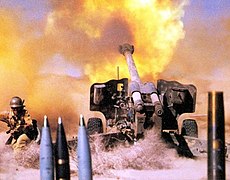
Most forms of artillery require a propellantto propel the projectile at the target. Propellant is always a low explosive, which means it deflagrates, rather than detonatinglike high explosives. The shell is accelerated to a high velocity in a very short time by the rapid generation of gas from the burning propellant. This high pressure is achieved by burning the propellant in a contained area, either the chamber of a gun barrel or the combustion chamber of a rocket motor.
Until the late 19th century, the only available propellant was black powder. It had many disadvantages as a propellant; it has relatively low power, requiring large amounts of powder to fire projectiles, and created thick clouds of white smoke that would obscure the targets, betray the positions of guns, and make aiming impossible. In 1846, nitrocellulose (also known as guncotton) was discovered, and the high explosive nitroglycerin was discovered at nearly the same time. Nitrocellulose was significantly more powerful than black powder, and was smokeless. Early guncotton was unstable, however, and burned very fast and hot, leading to greatly increased barrel wear. Widespread introduction of smokeless powder would wait until the advent of the double-base powders, which combine nitrocellulose and nitroglycerin to produce powerful, smokeless, stable propellant.
Many other formulations were developed in the following decades, generally trying to find the optimum characteristics of a good artillery propellant – low temperature, high energy, non-corrosive, highly stable, cheap, and easy to manufacture in large quantities. Modern gun propellants are broadly divided into three classes: single-base propellants that are mainly or entirely nitrocellulose based, double-base propellants consisting of a combination of nitrocellulose and nitroglycerin, and triple base composed of a combination of nitrocellulose and nitroglycerin and nitroguanidine.
Artillery shells fired from a barrel can be assisted to greater range in three ways:
- Rocket-assisted projectiles enhance and sustain the projectile's velocity by providing additional 'push' from a small rocket motor that is part of the projectile's base.
- Base bleed uses a small pyrotechnic charge at the base of the projectile to introduce sufficient combustion products into the low-pressure region behind the base of the projectile responsible for a large proportion of the drag.
- Ramjet-assisted, similar to rocket-assisted, but using a ramjet instead of a rocket motor; it is anticipated that a ramjet-assisted 120-mm mortar shell could reach a range of 22 mi (35 km).[67]
Propelling charges for tube artillery can be provided either as cartridge bags or in metal cartridge cases. Generally, anti-aircraft artillery and smaller-caliber (up to 3" or 76.2 mm) guns use metal cartridge cases that include the round and propellant, similar to a modern rifle cartridge. This simplifies loading and is necessary for very high rates of fire. Bagged propellant allows the amount of powder to be raised or lowered, depending on the range to the target. It also makes handling of larger shells easier. Cases and bags require totally different types of breech. A metal case holds an integral primer to initiate the propellant and provides the gas seal to prevent the gases leaking out of the breech; this is called obturation. With bagged charges, the breech itself provides obturation and holds the primer. In either case, the primer is usually percussion, but electrical is also used, and laser ignition is emerging. Modern 155 mm guns have a primer magazine fitted to their breech.

Artillery ammunition has four classifications according to use:
- Service: ammunition used in live fire training or for wartime use in a combat zone. Also known as "warshot" ammunition.
- Practice: Ammunition with a non- or minimally-explosive projectile that mimics the characteristics (range, accuracy) of live rounds for use under training conditions. Practice artillery ammunition often utilizes a colored-smoke-generating bursting charge for marking purposes in place of the normal high-explosive charge.
- Dummy: Ammunition with an inert warhead, inert primer, and no propellant; used for training or display.
- Blank: Ammunition with live primer, greatly reduced propellant charge (typically black powder), and no projectile; used for training, demonstration or ceremonial use.