Historically, cavalry (from the French word cavalerie, itself derived from "cheval" meaning "horse") are soldiers or warriors who fight mounted on horseback. Cavalry were the most mobile of the combat arms, operating as light cavalry in the roles of reconnaissance, screening, and skirmishing in many armies, or as heavy cavalry for decisive shock attacks in other armies. An individual soldier in the cavalry is known by a number of designations depending on era and tactics, such as cavalryman, horseman, trooper, cataphract, knight, hussar, uhlan, mamluk, cuirassier, lancer, dragoon, or horse archer. The designation of cavalry was not usually given to any military forces that used other animalsfor mounts, such as camels or elephants. Infantry who moved on horseback, but dismounted to fight on foot, were known in the early 17th to the early 18th century as dragoons, a class of mounted infantry which in most armies later evolved into standard cavalry while retaining their historic designation.


Cavalry had the advantage of improved mobility, and a soldier fighting from horseback also had the advantages of greater height, speed, and inertial mass over an opponent on foot. Another element of horse mounted warfare is the psychological impact a mounted soldier can inflict on an opponent.
The speed, mobility, and shock value of cavalry was greatly appreciated and exploited in armed forces in the Ancient and Middle Ages; some forces were mostly cavalry, particularly in nomadic societies of Asia, notably the Huns of Attila and the later Mongol armies.[1] In Europe, cavalry became increasingly armoured (heavy), and eventually evolving into the mounted knights of the medieval period. During the 17th century, cavalry in Europe discarded most of its armor, which was ineffective against the muskets and cannons that were coming into common use, and by the mid-18th century armor had mainly fallen into obsolescence, although some regiments retained a small thickened cuirassthat offered protection against lances, sabres, and bayonets; including some protection against a shot from distance.
In the interwar period, while some cavalry still served during World War II (notably in the Red Army, the Mongolian People's Army, the Royal Italian Army, the Romanian Army, the Polish Land Forces, and light reconnaissance units within the Waffen SS) many cavalry units were converted into motorized infantry and mechanized infantry units, or reformed as tank troops. The cavalry tank or cruiser tank was one designed with a speed and purpose beyond that of infantry tanks and would subsequently develop into the main battle tank.
Most cavalry units that are horse-mounted in modern armies serve in purely ceremonial roles, or as mounted infantry in difficult terrain such as mountains or heavily forested areas. Modern usage of the term generally refers to units performing the role of reconnaissance, surveillance, and target acquisition (analogous to historical light cavalry) or main battle tank units (analogous to historical heavy cavalry).
Role
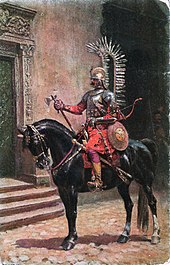
Historically, cavalry was divided into light cavalry and heavy cavalry. The differences were their roles in combat, the size of their mounts, and how much armor was worn by the mount and rider.
Heavy cavalry, such as Byzantine cataphractsand knights of the Early Middle Ages in Europe, were used as shock troops, charging the main body of the enemy at the height of a battle; in many cases their actions decided the outcome of the battle, hence the later term battle cavalry.[2] Light cavalry, such as horse archers, hussars, and Cossack cavalry, were assigned all the numerous roles that were ill-suited to more narrowly-focused heavy forces. This includes scouting, deterring enemy scouts, foraging, raiding, skirmishing, pursuit of retreating enemy forces, screeningof retreating friendly forces, linking separated friendly forces, and countering enemy light forces in all these same roles.
Light and heavy cavalry roles continued through early modern warfare, but armor was reduced, with light cavalry mostly unarmored. Yet many cavalry units still retained cuirassesand helmets for their protective value against sword and bayonet strikes, and the morale boost these provide to the wearers, despite these giving little protection from firearms. By this time the main difference between light and heavy cavalry was their training; the former was regarded as best suited for harassment and reconnaissance, while the latter was considered best for close-order charges. By the start of the 20th century, as total battlefield firepower increased, all cavalry tended to become dragoons in practice, riding mounted between battles, but dismounting to act as infantry during any battle, even if many retained their unit names that reflected their older cavalry roles.
With the development of armored warfare, the heavy cavalry role of decisive shock troopshad been taken over by armored unitsemploying medium and heavy tanks, and later main battle tanks.[3] Despite horse-born cavalry becoming obsolete, the term cavalry is still used, referring in modern times to units continuing to fulfill the traditional light cavalry roles, employing fast armored cars. light tanks, and infantry fighting vehiclesinstead of horses, while air cavalry employs helicopters.
Early history
Origins

Before the Iron Age, the role of cavalry on the battlefield was largely performed by light chariots. The chariot originated with the Sintashta-Petrovka culture in Central Asiaand spread by nomadic or semi-nomadic Indo-Iranians.[4] The chariot was quickly adopted by settled peoples both as a military technology and an object of ceremonial status, especially by the pharaohs of the New Kingdom of Egyptfrom 1550 BC as well as the Assyrian army and Babylonian royalty.[5]
The power of mobility given by mounted units was recognized early on, but was offset by the difficulty of raising large forces and by the inability of horses (then mostly small) to carry heavy armor. Nonetheless, there are indications that, from the 15th century BC onwards, horseback riding was practiced amongst the military elites of the great states of the ancient Near East, most notably those in Egypt, Assyria, the Hittite Empire, and Mycenaean Greece.[6]
Cavalry techniques, and the rise of true cavalry, were an innovation of equestrian nomads of the Central Asian and Iraniansteppe and pastoralist tribes such as the Iranic Parthians and Sarmatians.

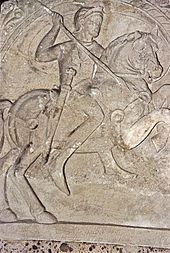
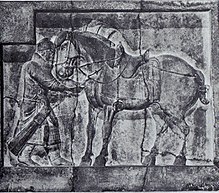
The photograph above left shows Assyrian cavalry from reliefs of 865–860 BC. At this time, the men had no spurs, saddles, saddle cloths, or stirrups. Fighting from the back of a horse was much more difficult than mere riding. The cavalry acted in pairs; the reins of the mounted archer were controlled by his neighbour's hand. Even at this early time, cavalry used swords, shields, spears, and bows. The sculpture implies two types of cavalry, but this might be a simplification by the artist. Later images of Assyrian cavalry show saddle cloths as primitive saddles, allowing each archer to control his own horse.[7]
As early as 490 BC a breed of large horseswas bred in the Nisaean plain in Media to carry men with increasing amounts of armour(Herodotus 7,40 & 9,20), but large horses were still very exceptional at this time. By the fourth century BC the Chinese during the Warring States period (403–221 BC) began to use cavalry against rival states,[8] and by 331 BC when Alexander the Great defeated the Persians the use of chariots in battle was obsolete in most nations; despite a few ineffective attempts to revive scythed chariots. The last recorded use of chariots as a shock force in continental Europe was during the Battle of Telamon in 225 BC.[9]However, chariots remained in use for ceremonial purposes such as carrying the victorious general in a Roman triumph, or for racing.
Outside of mainland Europe, the southern Britons met Julius Caesar with chariots in 55 and 54 BC, but by the time of the Roman conquest of Britain a century later chariots were obsolete, even in Britannia. The last mention of chariot use in Britain was by the Caledonians at the Mons Graupius, in 84 AD.
Ancient Greece: city-states, Thebes, Thessaly and Macedonia

During the classical Greek period cavalry were usually limited to those citizens who could afford expensive war-horses. Three types of cavalry became common: light cavalry, whose riders, armed with javelins, could harass and skirmish; heavy cavalry, whose troopers, using lances, had the ability to close in on their opponents; and finally those whose equipment allowed them to fight either on horseback or foot. The role of horsemen did however remain secondary to that of the hoplites or heavy infantry who comprised the main strength of the citizen levies of the various city states.[10]
Cavalry played a relatively minor role in ancient Greek city-states, with conflicts decided by massed armored infantry. However, Thebes produced Pelopidas, their first great cavalry commander, whose tactics and skills were absorbed by Philip II of Macedon when Philip was a guest-hostage in Thebes. Thessaly was widely known for producing competent cavalrymen,[11] and later experiences in wars both with and against the Persians taught the Greeks the value of cavalry in skirmishing and pursuit. The Athenian author and soldier Xenophon in particular advocated the creation of a small but well-trained cavalry force; to that end, he wrote several manuals on horsemanship and cavalry operations.[12]
The Macedonian Kingdom in the north, on the other hand, developed a strong cavalry force that culminated in the hetairoi (Companion cavalry)[13] of Philip II of Macedon and Alexander the Great. In addition to these heavy cavalry, the Macedonian army also employed lighter horsemen[14] called prodromoi for scouting and screening, as well as the Macedonian pike phalanx and various kinds of light infantry. There were also the Ippiko (or "Horserider"), Greek "heavy" cavalry, armed with kontos (or cavalry lance), and sword. These wore leather armour or mail plus a helmet. They were medium rather than heavy cavalry, meaning that they were better suited to be scouts, skirmishers, and pursuers rather than front line fighters. The effectiveness of this combination of cavalry and infantry helped to break enemy lines and was most dramatically demonstrated in Alexander's conquests of Persia, Bactria, and northwestern India.[15]
Roman Republic and Early Empire
The cavalry in the early Roman Republicremained the preserve of the wealthy landed class known as the equites—men who could afford the expense of maintaining a horse in addition to arms and armor heavier than those of the common legions. Horses were provided by the Republic and could be withdrawn if neglected or misused, together with the status of being a cavalryman.[16]
As the class grew to be more of a social elite instead of a functional property-based military grouping, the Romans began to employ Italian socii for filling the ranks of their cavalry.[17] The weakness of Roman cavalry was demonstrated by Hannibal Barca during the Second Punic War where he used his superior mounted forces to win several battles. The most notable of these was the Battle of Cannae, where he inflicted a catastrophic defeat on the Romans. At about the same time the Romans began to recruit foreign auxiliary cavalry from among Gauls, Iberians, and Numidians, the last being highly valued as mounted skirmishers and scouts (see Numidian cavalry). Julius Caesar had a high opinion of his escort of Germanic mixed cavalry, giving rise to the Cohortes Equitatae. Early emperors maintained an ala of Bataviancavalry as their personal bodyguards until the unit was dismissed by Galba after the Batavian Rebellion.[18]
For the most part, Roman cavalry during the early Republic functioned as an adjunct to the legionary infantry and formed only one-fifth of the standing force comprising a consular army. Except in times of major mobilisation about 1,800 horsemen were maintained, with three hundred attached to each legion.[19] The relatively low ratio of horsemen to infantry does not mean that the utility of cavalry should be underestimated, as its strategic role in scouting, skirmishing, and outpost duties was crucial to the Romans' capability to conduct operations over long distances in hostile or unfamiliar territory. On some occasions Roman cavalry also proved its ability to strike a decisive tactical blow against a weakened or unprepared enemy, such as the final charge at the Battle of Aquilonia.[20]
After defeats such as the Battle of Carrhae, the Romans learned the importance of large cavalry formations from the Parthians.[21] At the same time heavy spears and shields modelled on those favoured by the horsemen of the Greek city-states were adopted to replace the lighter weaponry of early Rome.[22] These improvements in tactics and equipment reflected those of a thousand years earlier when the first Iranians to reach the Iranian Plateau forced the Assyrians to undertake similar reform. Nonetheless, the Romans would continue to rely mainly on their heavy infantry supported by auxiliary cavalry.
Late Roman Empire and the Migration Period

In the army of the late Roman Empire, cavalry played an increasingly important role. The Spatha, the classical sword throughout most of the 1st millennium was adopted as the standard model for the Empire's cavalry forces. By the 6th century these had evolved into lengthy straight weapons influenced by Persian and other eastern patterns.[23]
The most widespread employment of heavy cavalry at this time was found in the forces of the Iranian empires, the Parthians and their Persian Sasanian successors. Both, but especially the former, were famed for the cataphract (fully armored cavalry armed with lances) even though the majority of their forces consisted of lighter horse archers. The West first encountered this eastern heavy cavalry during the Hellenistic period with further intensive contacts during the eight centuries of the Roman–Persian Wars. At first the Parthians' mobility greatly confounded the Romans, whose armoured close-order infantry proved unable to match the speed of the Parthians. However, later the Romans would successfully adapt such heavy armor and cavalry tactics by creating their own units of cataphracts and clibanarii.[24]
The decline of the Roman infrastructure made it more difficult to field large infantry forces, and during the 4th and 5th centuries cavalry began to take a more dominant role on the European battlefield, also in part made possible by the appearance of new, larger breeds of horses. The replacement of the Roman saddle by variants on the Scythian model, with pommel and cantle,[25] was also a significant factor as was the adoption of stirrups and the concomitant increase in stability of the rider's seat. Armored cataphracts began to be deployed in eastern Europe and the Near East, following the precedents established by Persian forces, as the main striking force of the armies in contrast to the earlier roles of cavalry as scouts, raiders, and outflankers.[26]
The late-Roman cavalry tradition of organized units in a standing army differed fundamentally from the nobility of the Germanic invaders—individual warriors who could afford to provide their own horses and equipment. While there was no direct linkage with these predecessors the early medieval knight also developed as a member of a social and martial elite, able to meet the considerable expenses required by his role from grants of land and other incomes.[27]
Asia

Central Asia
Xiongnu, Tujue, Avars, Kipchaks, Khitans, Mongols, Don Cossacks and the various Turkic peoples are also examples of the horse-mounted groups that managed to gain substantial successes in military conflicts with settled agrarian and urban societies, due to their strategic and tactical mobility. As European states began to assume the character of bureaucratic nation-statessupporting professional standing armies, recruitment of these mounted warriors was undertaken in order to fill the strategic roles of scouts and raiders.
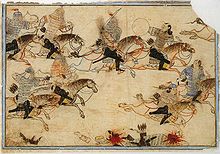
The best known instance of the continued employment of mounted tribal auxiliaries were the Cossack cavalry regiments of the Russian Empire. In Eastern Europe, and out onto the steppes, cavalry remained important much longer and dominated the scene of warfare until the early 17th century and even beyond, as the strategic mobility of cavalry was crucial for the semi-nomadic pastoralistlives that many steppe cultures led. Tibetansalso had a tradition of cavalry warfare, in several military engagements with the Chinese Tang dynasty (618–907 AD).
Khanates of Central Asia

East Asia
China


Further east, the military history of China, specifically northern China, held a long tradition of intense military exchange between Han Chinese infantry forces of the settled dynastic empires and the mounted nomads or "barbarians" of the north. The naval history of China was centered more to the south, where mountains, rivers, and large lakes necessitated the employment of a large and well-kept navy.
In 307 BC, King Wuling of Zhao, the ruler of the former state of Jin, ordered his commanders and troops to adopt the trousers of the nomads as well as practice the nomads' form of mounted archery to hone their new cavalry skills.[8]
The adoption of massed cavalry in China also broke the tradition of the chariot-riding Chinese aristocracy in battle, which had been in use since the ancient Shang Dynasty (c 1600–1050 BC).[28] By this time large Chinese infantry-based armies of 100,000 to 200,000 troops were now buttressed with several hundred thousand mounted cavalry in support or as an effective striking force.[29] The handheld pistol-and-trigger crossbow was invented in China in the fourth century BC;[30]it was written by the Song dynasty scholars Zeng Gongliang, Ding Du, and Yang Weide in their book Wujing Zongyao (1044 AD) that massed missile fire by crossbowmen was the most effective defense against enemy cavalry charges.[31]

On many occasions the Chinese studied nomadic cavalry tactics and applied the lessons in creating their own potent cavalry forces, while in others they simply recruited the tribal horsemen wholesale into their armies; and in yet other cases nomadic empires proved eager to enlist Chinese infantry and engineering, as in the case of the Mongol Empire and its sinicized part, the Yuan Dynasty (1279–1368). The Chinese recognized early on during the Han Dynasty(202 BC – 220 AD) that they were at a disadvantage in lacking the number of horses the northern nomadic peoples mustered in their armies. Emperor Wu of Han (r 141–87 BC) went to war with the Dayuan for this reason, since the Dayuan were hoarding a massive amount of tall, strong, Central Asian bred horses in the Hellenized–Greek region of Fergana (established slightly earlier by Alexander the Great). Although experiencing some defeats early on in the campaign, Emperor Wu's war from 104 BC to 102 BC succeeded in gathering the prized tribute of horses from Fergana.
Cavalry tactics in China were enhanced by the invention of the saddle-attached stirrup by at least the 4th century, as the oldest reliable depiction of a rider with paired stirrups was found in a Jin Dynasty tomb of the year 322 AD.[32][33][34] The Chinese invention of the horse collar by the 5th century was also a great improvement from the breast harness, allowing the horse to haul greater weight without heavy burden on its skeletal structure.[35][36]
Korea
The horse warfare of Korea was first started during the ancient Korean kingdom Gojoseon. Since at least the 3rd century BC, there was influence of northern nomadic peoples and Yemaek peoples on Korean warfare. By roughly the first century BC, the ancient kingdom of Buyeo also had mounted warriors.[37] The cavalry of Goguryeo, one of the Three Kingdoms of Korea, were called Gaemamusa (개마무사, 鎧馬武士), and were renowned as a fearsome heavy cavalry force. King Gwanggaeto the Great often led expeditions into the Baekje, Gaya confederacy, Buyeo, Later Yan and against Japanese invaders with his cavalry.[38]
In the 12th century, Jurchen tribes began to violate the Goryeo–Jurchen borders, and eventually invaded Goryeo Korea. After experiencing the invasion by the Jurchen, Korean general Yun Gwan realized that Goryeo lacked efficient cavalry units. He reorganized the Goryeo military into a professional army that would contain decent and well-trained cavalry units. In 1107, the Jurchen were ultimately defeated, and surrendered to Yun Gwan. To mark the victory, General Yun built nine fortresses to the northeast of the Goryeo–Jurchen borders (동북 9성, 東北 九城).

Japan

The ancient Japanese of the Kofun period also adopted cavalry and equine culture by the 5th century AD. The emergence of the samuraiaristocracy led to the development of armoured horse archers, themselves to develop into charging lancer cavalry as gunpowder weapons rendered bows obsolete. Japanese cavalry was largely made up of landowners who would be upon a horse to better survey the troops they were called upon to bring to an engagement, rather than traditional mounted warfare seen in other cultures with massed cavalry units.
An example is Yabusame (流鏑馬?), a type of mounted archery in traditional Japanese archery. An archer on a running horse shoots three special "turnip-headed" arrows successively at three wooden targets.
This style of archery has its origins at the beginning of the Kamakura period. Minamoto no Yoritomo became alarmed at the lack of archery skills his samurai had. He organized yabusame as a form of practice. Currently, the best places to see yabusame performed are at the Tsurugaoka Hachiman-gū in Kamakura and Shimogamo Shrine in Kyoto (during Aoi Matsuri in early May). It is also performed in Samukawa and on the beach at Zushi, as well as other locations.
Kasagake or Kasakake (笠懸, かさがけ lit. "hat shooting") is a type of Japanese mounted archery. In contrast to yabusame, the types of targets are various and the archer shoots without stopping the horse. While yabusame has been played as a part of formal ceremonies, kasagake has developed as a game or practice of martial arts, focusing on technical elements of horse archery.
South Asia
Indian subcontinent
In the Indian subcontinent, cavalry played a major role from the Gupta Dynasty (320–600) period onwards. India has also the oldest evidence for the introduction of toe-stirrups.[39]
Indian literature contains numerous references to the mounted warriors of the Central Asian horse nomads, notably the Sakas, Kambojas, Yavanas, Pahlavas and Paradas. Numerous Puranic texts refer to a conflict in ancient India (16th century BC)[40]in which the horsemen of five nations, called the "Five Hordes" (pañca.ganan) or Kṣatriyahordes (Kṣatriya ganah), attacked and captured the state of Ayudhya by dethroning its Vedic King Bahu[41]
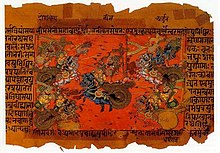
The Mahabharata, Ramayana, numerous Puranas and some foreign sources attest that the Kamboja cavalry frequently played role in ancient wars. V. R. Ramachandra Dikshitar writes: "Both the Puranas and the epics agree that the horses of the Sindhu and Kamboja regions were of the finest breed, and that the services of the Kambojas as cavalry troopers were utilised in ancient wars".[42] J.A.O.S. writes: "Most famous horses are said to come either from Sindhu or Kamboja; of the latter (i.e. the Kamboja), the Indian epicMahabharata speaks among the finest horsemen".[43]


The Mahabharata speaks of the esteemed cavalry of the Kambojas, Sakas, Yavanas and Tusharas, all of whom had participated in the Kurukshetra war under the supreme command of Kamboja ruler Sudakshin Kamboj.[44]
Mahabharata and Vishnudharmottara Purana pay especial attention to the Kambojas, Yavansa, Gandharas etc. being ashva.yuddha.kushalah (expert cavalrymen).[45] In the Mahabharata war, the Kamboja cavalry along with that of the Sakas, Yavanas is reported to have been enlisted by the Kuru king Duryodhana of Hastinapura.[46]
Herodotus (c 484 – c 425 BC) attests that the Gandarian mercenaries (i.e. Gandharans/Kambojans of Gandari Strapy of Achaemenids) from the 20th strapy of the Achaemenids were recruited in the army of emperor Xerxes I (486–465 BC), which he led against the Hellas.[47] Similarly, the men of the Mountain Land from north of Kabul-River equivalent to medieval Kohistan (Pakistan), figure in the army of Darius III against Alexander at Arbela, providing a cavalry force and 15 elephants.[48] This obviously refers to Kamboja cavalry south of Hindukush.
The Kambojas were famous for their horses, as well as cavalrymen (asva-yuddha-Kushalah).[49] On account of their supreme position in horse (Ashva) culture, they were also popularly known as Ashvakas, i.e. the "horsemen"[50] and their land was known as "Home of Horses".[51] They are the Assakenoiand Aspasioi of the Classical writings, and the Ashvakayanas and Ashvayanas in Pāṇini's Ashtadhyayi. The Assakenoi had faced Alexander with 30,000 infantry, 20,000 cavalry and 30 war elephants.[52] Scholars have identified the Assakenoi and Aspasioi clans of Kunar and Swat valleys as a section of the Kambojas.[53] These hardy tribes had offered stubborn resistance to Alexander (c 326 BC) during latter's campaign of the Kabul, Kunar and Swat valleys and had even extracted the praise of the Alexander's historians. These highlanders, designated as "parvatiya Ayudhajivinah" in Pāṇini's Astadhyayi,[54] were rebellious, fiercely independent and freedom-loving cavalrymen who never easily yielded to any overlord.[55]
The Sanskrit drama Mudra-rakashas by Visakha Dutta and the Jaina work Parishishtaparvan refer to Chandragupta's (c 320 BC – c 298 BC) alliance with Himalayanking Parvataka. The Himalayan alliance gave Chandragupta a formidable composite army made up of the cavalry forces of the Shakas, Yavanas, Kambojas, Kiratas, Parasikas and Bahlikas as attested by Mudra-Rakashas (Mudra-Rakshasa 2).[56] These hordes had helped Chandragupta Maurya defeat the ruler of Magadha and placed Chandragupta on the throne, thus laying the foundations of Mauryan Dynasty in Northern India.
The cavalry of Hunas and the Kambojas is also attested in the Raghu Vamsa epic poem of Sanskrit poet Kalidasa.[57] Raghu of Kalidasa is believed to be Chandragupta II(Vikaramaditya) (375–413/15 AD), of the well-known Gupta Dynasty.
As late as the mediaeval era, the Kamboja cavalry had also formed part of the Gurjara-Pratihara armed forces from the eighth to the 10th centuries AD. They had come to Bengalwith the Pratiharas when the latter conquered part of the province.[58][59][60][61][62]
Ancient Kambojas organised military sanghasand shrenis (corporations) to manage their political and military affairs, as Arthashastraof Kautiliya as well as the Mahabharatarecord. They are described as Ayuddha-jivi or Shastr-opajivis (nations-in-arms), which also means that the Kamboja cavalry offered its military services to other nations as well. There are numerous references to Kambojas having been requisitioned as cavalry troopersin ancient wars by outside nations.
Mughal Empire

The Mughal armies (lashkar) were primarily a cavalry force. The elite corps were the ahadiwho provided direct service to the Emperor and acted as guard cavalry. Supplementary cavalry or dakhilis were recruited, equipped and paid by the central state. This was in contrast to the tabinan horsemen who were the followers of individual noblemen. Their training and equipment varied widely but they made up the backbone of the Mughal cavalry. Finally there were tribal irregulars led by and loyal to tributary chiefs. These included Hindus, Afghans and Turks summoned for military service when their autonomous leaders were called on by the Imperial government.[63]
European Middle Ages

As the quality and availability of heavy infantry declined in Europe with the fall of the Roman Empire, heavy cavalry became more effective. Infantry that lack the cohesion and discipline of tight formations are more susceptible to being broken and scattered by shock combat—the main role of heavy cavalry, which rose to become the dominant force on the European battlefield.[64]
As heavy cavalry increased in importance, it became the main focus of military development. The arms and armour for heavy cavalry increased, the high-backed saddledeveloped, and stirrups and spurs were added, increasing the advantage of heavy cavalry even more.[65]
This shift in military importance was reflected in society as well; knights took centre stage both on and off the battlefield. These are considered the "ultimate" in heavy cavalry: well-equipped with the best weapons, state-of-the-art armour from head to foot, leading with the lance in battle in a full-gallop, close-formation "knightly charge" that might prove irresistible, winning the battle almost as soon as it begun.

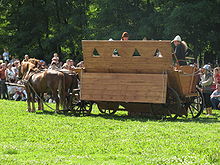
But knights remained the minority of total available combat forces; the expense of arms, armour, and horses was only affordable to a select few. While mounted men-at-arms focused on a narrow combat role of shock combat, medieval armies relied on a large variety of foot troops to fulfill all the rest (skirmishing, flank guards, scouting, holding ground, etc.). Medieval chroniclers tended to pay undue attention to the knights at the expense of the common soldiers, which led early students of military history to suppose that heavy cavalry was the only force that mattered on medieval European battlefields. But well-trained and disciplined infantry could defeat knights.
Massed English longbowmen triumphed over French cavalry at Crécy, Poitiers and Agincourt, while at Gisors (1188), Bannockburn(1314), and Laupen (1339),[66] foot-soldiers proved they could resist cavalry charges as long as they held their formation. Once the Swiss developed their pike squares for offensive as well as defensive use, infantry started to become the principal arm. This aggressive new doctrine gave the Swiss victory over a range of adversaries, and their enemies found that the only reliable way to defeat them was by the use of an even more comprehensive combined arms doctrine, as evidenced in the Battle of Marignano. The introduction of missile weapons that required less skill than the longbow, such as the crossbow and hand cannon, also helped remove the focus somewhat from cavalry elites to masses of cheap infantry equipped with easy-to-learn weapons. These missile weapons were very successfully used in the Hussite Wars, in combination with Wagenburgtactics.
This gradual rise in the dominance of infantry led to the adoption of dismounted tactics. From the earliest times knights and mounted men-at-arms had frequently dismounted to handle enemies they could not overcome on horseback, such as in the Battle of the Dyle(891) and the Battle of Bremule (1119), but after the 1350s this trend became more marked with the dismounted men-at-arms fighting as super-heavy infantry with two-handed swords and poleaxes.[citation needed] In any case, warfare in the Middle Ages tended to be dominated by raids and sieges rather than pitched battles, and mounted men-at-arms rarely had any choice other than dismounting when faced with the prospect of assaulting a fortified position.
Greater Middle East
Arabs
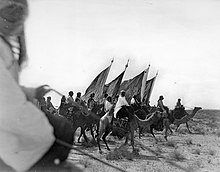
The Islamic Prophet Muhammad made use of cavalry in many of his military campaigns including the Expedition of Dhu Qarad,[67] and the expedition of Zaid ibn Haritha in al-Iswhich took place in September, 627 AD, fifth month of 6 AH of the Islamic calendar.[68]
Early organized Arab mounted forces under the Rashidun caliphate comprised a light cavalry armed with lance and sword. Its main role was to attack the enemy flanks and rear. These relatively lightly armored horsemen formed the most effective element of the Muslim armies during the later stages of the Islamic conquest of the Levant. The best use of this lightly armed fast moving cavalry was revealed at the Battle of Yarmouk (636 AD) in which Khalid ibn Walid, knowing the skills of his horsemen, used them to turn the tables at every critical instance of the battle with their ability to engage, disengage, then turn back and attack again from the flank or rear. A strong cavalry regiment was formed by Khalid ibn Walid which included the veterans of the campaign of Iraq and Syria. Early Muslim historians have given it the name Tali’a mutaharrikah(طليعة متحركة), or the Mobile guard. This was used as an advance guard and a strong striking force to route the opposing armies with its greater mobility that give it an upper hand when maneuvering against any Byzantine army. With this mobile striking force, the conquest of Syria was made easy.[69]
The Battle of Talas in 751 AD was a conflict between the Arab Abbasid Caliphate and the Chinese Tang dynasty over the control of Central Asia. Chinese infantry were routed by Arab cavalry near the bank of the River Talas.
Later Mamluks were trained as cavalry soldiers. Mamluks were to follow the dictates of al-furusiyya,[70] a code of conduct that included values like courage and generosity but also doctrine of cavalry tactics, horsemanship, archery and treatment of wounds.
Maghreb

The Islamic Berber states of North Africa employed elite horse mounted cavalry armed with spears and following the model of the original Arab occupiers of the region. Horse-harness and weapons were manufactured locally and the six-monthly stipends for horsemen were double those of their infantry counterparts. During the 8th century Islamic conquest of Iberia large numbers of horses and riders were shipped from North Africa, to specialise in raiding and the provision of support for the massed Berber footmen of the main armies.[71]
Maghrebi traditions of mounted warfare eventually influenced a number of sub-Saharan African polities in the medieval era. The Esos of Ikoyi, military aristocrats of the Yoruba peoples, were a notable manifestation of this phenomenon.[72]
Al-Andalus
Iran
Qizilbash, were a class of Safavid militant warriors in Iran during the 15th to 18th centuries, who often fought as elite cavalry.[73][74][75][76]
Ottoman Empire
During its period of greatest expansion, from the 14th to 17th centuries, cavalry formed the powerful core of the Ottoman armies. Registers dated 1475 record 22,000 Sipahifeudal cavalry levied in Europe, 17,000 Sipahisrecruited from Anatolia, and 3,000 Kapikulu(regular body-guard cavalry).[77] During the 18th century however the Ottoman mounted troops evolved into light cavalry serving in the thinly populated regions of the Middle East and North Africa.[78] Such frontier horsemen were largely raised by local governors and were separate from the main field armies of the Ottoman Empire. At the beginning of the 19th century modernised Nizam-I Credit ("New Army") regiments appeared, including full-time cavalry units officered from the horse guards of the Sultan.[79]


Renaissance Europe

Ironically, the rise of infantry in the early 16th century coincided with the "golden age" of heavy cavalry; a French or Spanish army at the beginning of the century could have up to half its numbers made up of various kinds of light and heavy cavalry, whereas in earlier medieval and later 17th-century armies the proportion of cavalry was seldom more than a quarter.
Knighthood largely lost its military functions and became more closely tied to social and economic prestige in an increasingly capitalistic Western society. With the rise of drilled and trained infantry, the mounted men-at-arms, now sometimes called gendarmesand often part of the standing army themselves, adopted the same role as in the Hellenistic age, that of delivering a decisive blow once the battle was already engaged, either by charging the enemy in the flank or attacking their commander-in-chief.
From the 1550s onwards, the use of gunpowder weapons solidified infantry's dominance of the battlefield and began to allow true mass armies to develop. This is closely related to the increase in the size of armies throughout the early modern period; heavily armored cavalrymen were expensive to raise and maintain and it took years to train a skilled horseman or a horse, while arquebusiers and later musketeers could be trained and kept in the field at much lower cost, and were much easier to recruit.
The Spanish tercio and later formations relegated cavalry to a supporting role. The pistol was specifically developed to try to bring cavalry back into the conflict, together with manoeuvres such as the caracole. The caracole was not particularly successful, however, and the charge (whether with lance, sword, or pistol) remained as the primary mode of employment for many types of European cavalry, although by this time it was delivered in much deeper formations and with greater discipline than before. The demi-lancers and the heavily armored sword-and-pistol reiters were among the types of cavalry whose heyday was in the 16th and 17th centuries, as for the Polish winged hussars, a heavy cavalry force that achieved great success against Swedes, Russians, and Turks.